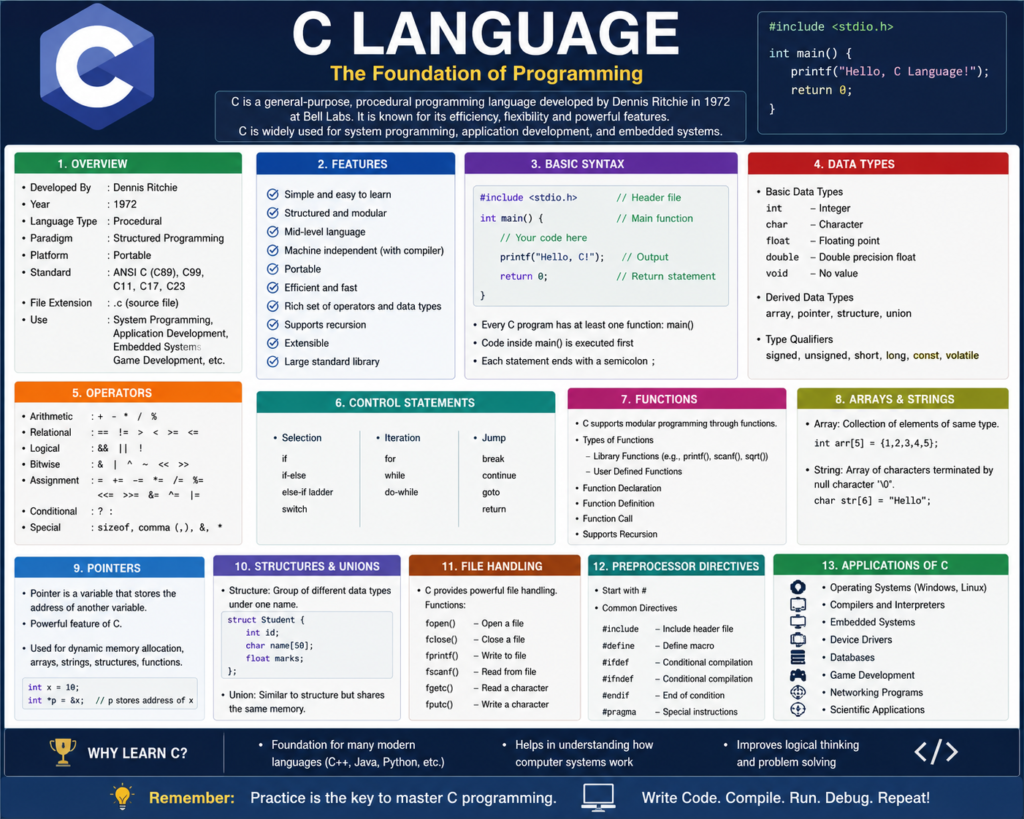
The C Language Course is designed for beginners and aspiring programmers who want to build a strong foundation in computer programming. This course covers essential concepts such as variables, data types, operators, loops, functions, arrays, pointers, structures, and file handling. Through practical exercises and real-world examples, students gain hands-on experience in writing efficient C programs. Whether you are a student, job seeker, or professional looking to enhance your coding skills, this C Language Course provides the knowledge and confidence needed to start a successful programming journey.
Module 1: Introduction to C Programming
Learn the basics of programming, history of C language, features of C, and setting up the programming environment.
Module 2: Structure of a C Program
Understand the components of a C program, syntax rules, keywords, identifiers, and writing your first program.
Module 3: Variables and Data Types
Learn about variables, constants, data types, and memory allocation in C.
Module 4: Input and Output Functions
Work with printf(), scanf(), format specifiers, and user interaction through console applications.
Module 5: Operators in C
Understand arithmetic, relational, logical, assignment, increment/decrement, and bitwise operators.
Module 6: Decision Making Statements
Learn conditional statements such as if, if-else, nested if, and switch-case.
Module 7: Looping Statements
Master loops including for, while, and do-while for repetitive tasks.
Module 8: Arrays
Learn one-dimensional and two-dimensional arrays, array operations, and practical applications.
Module 9: Strings in C
Understand string handling, string functions, and text manipulation techniques.
Module 10: Functions
Create and use functions, parameter passing, return values, recursion, and code reusability.
Module 11: Pointers
Learn memory addresses, pointer variables, pointer arithmetic, and dynamic memory concepts.
Module 12: Structures and Unions
Organize complex data using structures and unions for real-world applications.
Module 13: Storage Classes
Understand auto, static, extern, and register storage classes in C programming.
Module 14: File Handling
Learn to create, read, write, and manage files using file operations in C.
Module 15: Dynamic Memory Allocation
Work with malloc(), calloc(), realloc(), and free() for efficient memory management.
Module 16: Preprocessor Directives
Use macros, header files, conditional compilation, and other preprocessor features.
Module 17: Command Line Arguments
Learn how programs receive and process arguments from the command line.
Module 18: Error Handling and Debugging
Identify, troubleshoot, and fix programming errors using debugging techniques.
Module 19: Data Structures Using C
Introduction to stacks, queues, linked lists, and basic data structure concepts.
Module 20: Mini Projects and Practical Applications
Build real-world projects such as Student Management System, Library Management System, Banking System, and Calculator Applications.
Course Outcome
After completing this course, students will:
- Understand core programming concepts.
- Develop logical and problem-solving skills.
- Create console-based applications using C.
- Work with files, pointers, arrays, and structures.
- Build a strong foundation for C++, Java, Python, and Data Structures.
- Be prepared for programming interviews and software development careers.
Course Duration: 2–3 Months
Level: Beginner to Intermediate
Eligibility: 10th Pass, 12th Pass, College Students, Job Seekers, and Working Professionals.
For more information follow our Instagram id : https://www.instagram.com/networknetindia2005/
Enroll now : https://networknet.co.in/enroll-now